
School of Mechanical Engineering, Universiti Sains Malaysia
Undergraduate programme
Bachelor of Mechanical Engineering
Mechanical engineering encompasses design, management, production, maintenance and infrastructure development, and mechanical engineers make effective use of available resources to develop efficient, reliable and economical products and systems across a wide range of industrial sectors.
- Related disciplines
- 5
- Industries
- 7
- Professional skills
- 3
- Training components
- 3
Mechanical engineering at the centreFive linked disciplines and seven industries
Programme overview
- Broad engineering foundationPreparation for careers across the full spectrum of mechanical engineering.
- Interdisciplinary learningExposure to five related engineering disciplines plus management skills.
- Hands-on trainingLaboratory courses, workshop practice and industrial training.
Mechanical engineers play important roles across many industries. Their contributions are essential to infrastructure development, industrial advancement and economic growth.
The Bachelor of Mechanical Engineering programme at Universiti Sains Malaysia prepares students for engineering careers across a broad spectrum of mechanical engineering fields, while promoting interdisciplinary learning with related engineering disciplines.
Beyond technical competence, students are exposed to non-technical areas such as management, accounting and communication skills, so they are well prepared for the professional engineering environment.
Interdisciplinary learning with
Industries where mechanical engineers contribute
- Power generation
- Heavy machinery
- Electronics
- Construction
- Product development
- Medical equipment
- Food processing
Professional skills
Main areas of study
Each short animation shows a typical problem that engineers in that area learn to solve.
-
A loaded beam bends. Colours show where stress is highest. Applied mechanics
How structures and machine parts carry load, deform, move and vibrate, and how to predict failure before it occurs.
-
Flow splits around a cylinder while a heated wall warms the fluid. Thermofluids
How fluids flow and how heat and energy are transferred, converted and managed in engines, buildings and power systems.
-
A part is inspected, measured and placed by a robot. Systems, manufacturing technology, measurement and control
How products are made, measured and controlled, from machining and quality control to sensors, robots and automated lines.
-
A sketch becomes a dimensioned model, then is tested. Design and laboratory
How ideas become engineered products, through drawing, computer-aided design, hands-on laboratory work and the final year project.
Professional preparation
The programme places strong emphasis on practical training relevant to the professional engineering environment, giving students valuable hands-on experience in real engineering settings.
Engineering laboratory courses
Structured experiments that connect engineering theory with measurement, testing and analysis.
Workshop practice
Practical work with tools, machines and fabrication processes used in engineering practice.
Industrial training
Placement in industry, where students apply their learning in a real professional setting.
The programme produces graduates who are technically competent, professionally prepared and ready to pursue membership in relevant professional engineering organisations.
Programme brochure
The programme brochure provides additional information about the Bachelor of Mechanical Engineering curriculum, academic structure and student learning experience.
Please refer to the School of Mechanical Engineering for the most updated programme information and booklet details.

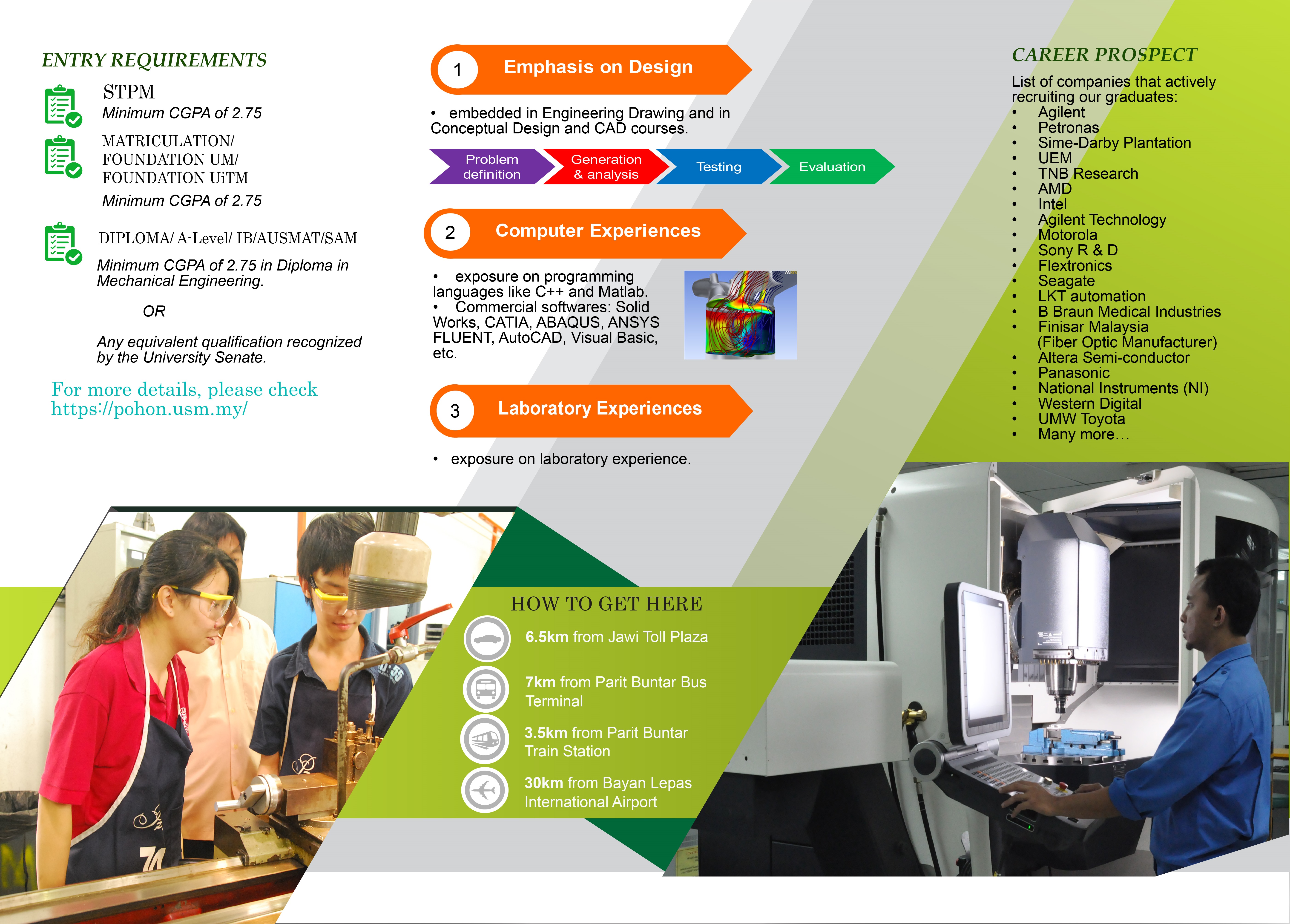
Programme booklet
Download the programme booklet for the full details of the Bachelor of Mechanical Engineering, or open it in your browser.